

What makes a travel partnership Dubai businesses build useful beyond passing along bookings? The strongest collaborations connect an overseas seller’s customer relationships with a local partner’s destination knowledge and coordinated trip planning. Clear ownership matters when activities need to fit around a traveler’s wider itinerary or a business event.
Dubai travel partnerships are moving beyond simple referrals towards more coordinated, locally informed experiences. For an overseas agency and a Dubai-based operator, that means agreeing who plans local activities, who manages traveler communication, and how itinerary details are shared. This article looks at practical ways to divide those tasks and connect Dubai experiences with wider UAE travel plans.
From Dubai city tours and desert safaris to activities in other Emirates, local coordination can help bring separate plans together. City Rise Tourism’s INBOUND TOURS & SAFARIS includes more than 30 tour bouquets within Dubai and the other Emirates, giving travel partners experiences to consider when planning a visit.
Key Takeaways
- A travel partnership Dubai businesses build works best when overseas sellers and local specialists clearly divide responsibilities.
- Connected planning, destination knowledge, and clear communication help partners coordinate trip details.
- Use a simple sequence: define traveler needs, assign tasks, align arrangements, and agree how updates will be shared.
- City Rise Tourism’s local knowledge and INBOUND TOURS & SAFARIS support professional travel arrangements across the UAE.
Why Travel Partnerships in Dubai Matter to Today’s Travel Businesses
A travel partnership brings travel businesses and local destination specialists together to plan and deliver parts of a journey. It might involve a referral, or closer coordination on itinerary details and local arrangements. In Dubai, a traveler may combine city activities with visits to other Emirates, so partners need to make clear where one party’s work ends and the other’s begins. The value of a travel partnership Dubai businesses develop lies in making that handoff clear and practical.
What does a travel partnership in Dubai involve?
An overseas travel business may lead customer communication and understand the traveler’s preferences, while a Dubai-based operator contributes local knowledge and coordinates destination arrangements. The division depends on the trip. A referral relationship may end when a booking is passed on; a more connected partnership can include selecting activities, aligning them with the itinerary, and sharing updates as plans take shape. In either case, define who owns each task and who tells the traveler about changes.
Why local coordination matters to travelers
Dubai offers varied activities, and itineraries can extend across the UAE. That creates practical questions: how does each activity fit the wider schedule, who shares the relevant details, and who communicates changes to the traveler? Agreeing on responsibilities helps partners avoid gaps, duplicate messages, and conflicting information. For background on the destination’s development and tourism sector, see Tourism in Dubai.
The shift is from simple referrals towards collaboration that brings customer relationships, local insight, and trip coordination together. For travel businesses, the practical test is whether both partners know what they are responsible for and have a straightforward way to share itinerary updates. That clarity can make the journey feel more connected for travelers.
Three Travel Partnership Trends Shaping Dubai’s Tourism Operations
Partnership trends are less about adopting one model and more about connecting the right parts of a trip. Three useful patterns stand out: planning across bookings, applying local insight, and keeping partner communication clear. Together, they show how travel businesses can combine digital coordination with hands-on destination knowledge.
From separate bookings to more connected travel planning
A flight, hotel, activity, and transfer may be booked separately, but the traveler experiences them as one journey. Partners can make that journey more coherent by sharing relevant itinerary details, aligning activity arrangements with the wider plan, and agreeing who updates the traveler. Holidayme’s technology-led positioning offers one example of a focus on digital tools and connected services. Systems can organize information and pass updates along, but local knowledge helps partners decide which experience fits the traveler’s plans.
Local expertise as a partnership advantage
A Dubai-based operator can bring destination knowledge to activity selection and arrangements across the UAE. That perspective helps overseas partners connect traveler interests with Dubai experiences or plans that include other Emirates. For example, an itinerary can be shaped around the traveler’s priorities and the places they plan to visit, rather than treating each activity as an isolated booking. Digital platforms can support coordination; local expertise adds context to the choices behind the itinerary.
Clearer communication between partners
As trip planning becomes more connected, responsibilities need to be visible. Partners can agree who handles activity details, who shares itinerary changes, and how traveler updates are passed along. A simple handoff can include the latest itinerary, the name of the person responsible for the next action, and any details the other partner needs to communicate accurately. Clear roles help reduce duplicate messages and missing information without requiring every partnership to use the same process.
Digital coordination organizes the details; local knowledge gives those details destination context. Travel businesses can start by reviewing Dubai activity options and deciding how each experience might fit a wider itinerary. Explore things to do in Dubai.
How Travel Partners Can Turn Dubai Trends into Better Coordination
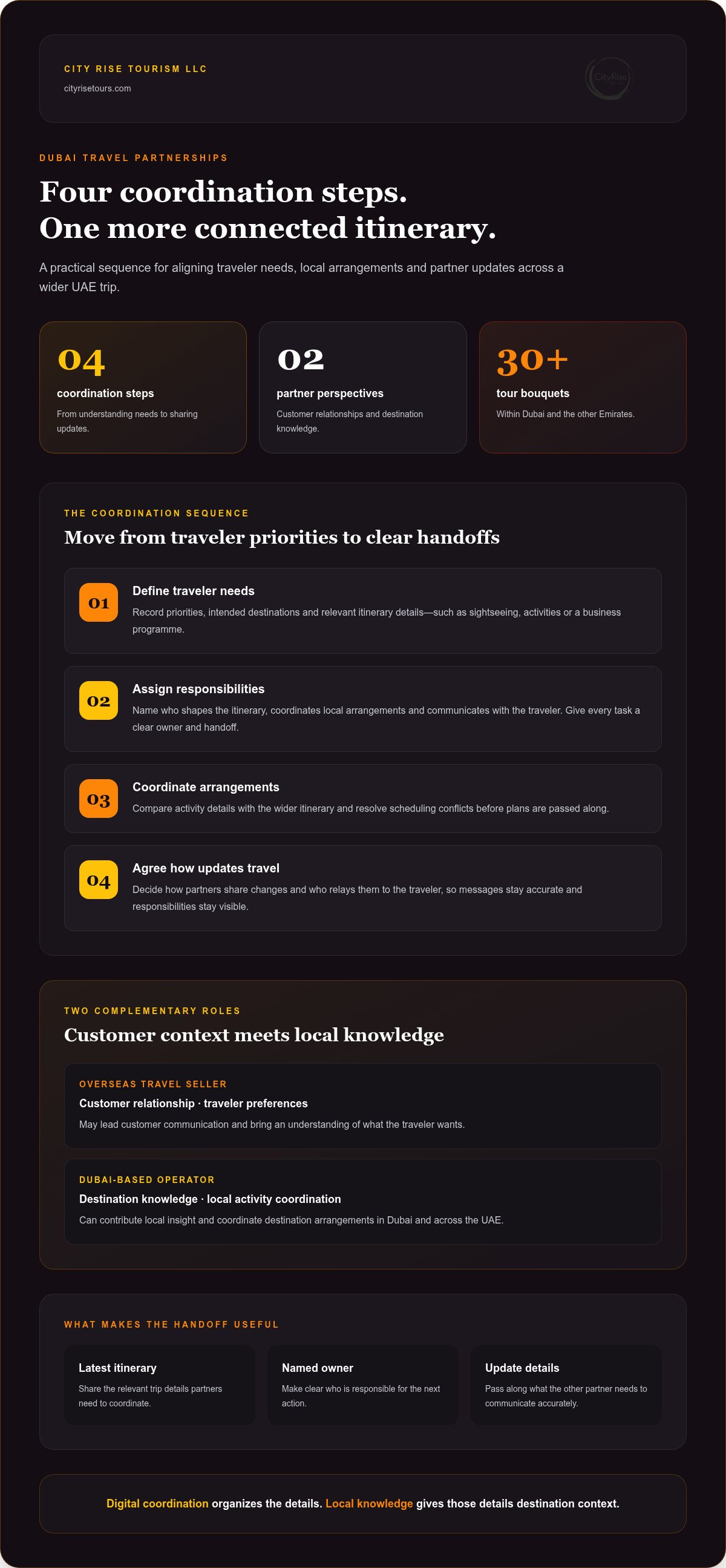
Good coordination starts before activities are added to an itinerary. Use this sequence: define traveler needs, assign responsibilities, coordinate arrangements, then agree how updates will be shared. It gives partners a practical framework for working together without leaving important tasks unassigned.
Set clear roles before building an itinerary
First, clarify what the traveler needs, such as sightseeing, activities, or a business programme. Then decide who will shape the itinerary, coordinate local arrangements, and communicate with the traveler. For example, an overseas seller may manage the customer relationship while a Dubai-based operator coordinates local activities. The exact division can vary, but each task should have a clear owner and a clear handoff.
- Define needs: Record traveler priorities, intended destinations, and relevant itinerary details.
- Assign responsibilities: Identify who plans, arranges, and communicates each part.
- Coordinate arrangements: Compare activity details with the wider itinerary and resolve any scheduling conflicts.
- Review communication: Agree how partners will share updates and who will relay them to the traveler.
Keep the traveler experience connected
Once roles are clear, compare the details of each itinerary component. Activity arrangements should fit the wider plan, and updates should reflect the same information across partners. If a traveler’s plans include more than one Emirate, for instance, make sure both partners have the current itinerary and know who will communicate any changes. A shared process matters more than a particular tool, and it helps keep each partner accountable for its part.
For B2B travel services in the UAE, local arrangements can connect with broader travel plans. Start the discussion with the itinerary, the traveler’s priorities, and the coordination tasks that need a local counterpart.
How City Rise Tourism Fits Dubai’s Evolving Travel Partnerships
City Rise Tourism is based in Dubai and provides professional B2B travel services, bringing local destination knowledge to travel arrangements across the UAE. For an overseas partner, that perspective can help connect a traveler’s interests with local activities and itinerary plans. Agreeing responsibilities and communication between partners keeps the working relationship clear from planning through to traveler updates.
Local activities and wider UAE itineraries
City Rise Tourism’s INBOUND TOURS & SAFARIS covers Dubai and other Emirates, with more than 30 tour bouquets. Examples include Desert Safari, Dubai City Tour, Dhow Dinner Cruise, and Abu Dhabi City Tour. These experiences give partners practical options to consider when shaping a Dubai visit or an itinerary that includes another Emirate. Travelers staying in Dubai Marina, Al Barsha Dubai, Dubai Downtown, Dubai JVC, or Dubai Production City can use their location and planned activities as part of the itinerary discussion. Explore Dubai activities and attractions for ideas to include in trip planning.
For business travel, CORPORATE supports arrangements for conferences, meetings, and incentive programmes. An overseas seller can bring its understanding of the traveler or organization; a Dubai-based partner can contribute local knowledge to the arrangements. Agreeing who handles planning, local coordination, and traveler communication helps keep the partnership practical and organized.
A practical next step for travel businesses
Start with three points: who the travelers are, what their intended UAE itinerary includes, and which coordination tasks need a local counterpart. That gives both partners a practical basis for discussing activities, arrangements, and communication. Businesses assessing an inbound tour operator in Dubai can use those priorities to evaluate how local coordination fits their travelers’ needs.
Explore Our Blogs for more travel planning insights.
Build More Connected UAE Travel Partnerships
A strong travel partnership Dubai businesses build goes beyond referrals. It brings overseas customer relationships together with local destination knowledge, clear responsibilities, and coordinated trip details. Digital tools can support communication, while local expertise helps shape arrangements around the destination and the traveler’s plans.
For a practical next step, define traveler needs, agree who handles each part of the itinerary, and set a clear approach to sharing updates. City Rise Tourism is a Dubai-based, privately owned travel agency with UAE destination knowledge. Its INBOUND TOURS & SAFARIS includes more than 30 tour bouquets across Dubai and the other Emirates, giving travel partners a range of local experiences to consider.
Whether a traveler is staying in Dubai Marina, Al Barsha Dubai, Dubai Downtown, Dubai JVC, or Dubai Production City, a clear itinerary and communication plan help connect local activities with the wider trip. Contact City Rise Tourism to discuss B2B travel arrangements and UAE itinerary planning.
Frequently Asked Questions
What is a travel partnership in Dubai?
A travel partnership Dubai businesses use is a coordinated working relationship between travel sellers and local destination specialists. An overseas agency may manage the customer relationship, while a Dubai-based operator contributes local activity planning and destination knowledge. Partners agree how responsibilities are divided for each trip. The arrangement may involve a referral, or extend to itinerary planning, local arrangements, and shared traveler updates.
Why do travel businesses partner with a Dubai-based operator?
A Dubai-based operator can add UAE destination knowledge to an overseas agency’s understanding of its travelers. City Rise Tourism LLC is a Dubai-based tour operator and trip planner offering professional B2B travel services, with more than 30 tour bouquets within Dubai and other Emirates. Local context can help shape plans for travelers staying in Dubai Marina, Al Barsha Dubai, Dubai Downtown, Dubai JVC, or Dubai Production City.
How can travel partners coordinate Dubai activities with an itinerary?
Partners can start by matching each activity to the wider itinerary, then clarify who handles the local arrangement and who shares updates with the traveler. If a plan includes a Dubai activity and a visit to another Emirate, align the activity details with the overall schedule and make sure both partners are working from the same information. Clear handoffs help keep separate arrangements connected.
What should a travel agency discuss with a Dubai travel partner?
Discuss the traveler’s priorities, the intended itinerary, and who will manage planning, local arrangements, and customer communication. For group or corporate travel, clarify whether the plans involve conferences, meetings, or incentive programmes. Also agree how itinerary changes and activity details will be shared. These practical points help both businesses understand their roles and coordinate the traveler’s experience with fewer gaps.


